Set Theory and Foundations of Mathematics
1. First foundations of mathematics
1.1. Introduction to the foundations of mathematics
What is mathematics
Mathematics is the study of systems of elementary objects, whose only considered
nature is to be exact, unambiguous (two objects are equal or different, related or not;
an operation gives an exact result...). Mathematics as a whole can be seen as
«the science of all possible worlds» of this kind (of exact objects).
Mathematical systems are conceived as «existing» independently of our usual world
or any particular sensation, but their study requires some form of representation.
Diverse ways can be used, that may be equivalent (giving the same results) but with
diverse degrees of relevance (efficiency) that may depend on purposes. Ideas may
first appear as more or less visual intuitions which may be expressed by drawing or
animations, then their articulations may be expressed in words or formulas for careful
checking, processing and communication. To be freed from the limits or biases of a
specific form of representation, is a matter of developing other forms of representation,
and exercizing to translate concepts between them. The mathematical
adventure is full of plays of conversions between forms of representation,
which may reflect articulations between mathematical systems themselves.
Theories
Mathematics is split into diverse branches according to the kind of systems
being considered. These frameworks of any mathematical work may either
remain implicit (with fuzzy limits), or formally specified as theories. Each
theory is the study of a supposedly fixed system that is its world of
objects, called its model. But each model of a theory may be just one of its
possible interpretations, among other possibly legitimate models. For example,
roughly speaking, all sheets of paper are systems of material points, models
of the same theory of Euclidean plane geometry, but independent of each other.
The word «theory» may take diverse meanings between uses, from mathematical
ones to those of ordinary language and other sciences.
Let us first present the distinction by nature (general kind of objects); the other distinction,
by intent (realism vs. formalism) is introduced below and in 1.9.
Non-mathematical theories describe roughly or qualitatively some systems
or aspects of the world (fields of observation) which escape exact self-sufficient
description. For example, usual descriptions of chemistry involve drastic approximations,
recollecting some rough accounts of seemingly arbitrary effects and laws, whose
deductions from quantum physics are often out of reach of direct calculations. The
lack of clear distinction of objects and their properties induces risks of mistakes when
approaching them and trying to infer some properties from others, such as to
infer some global properties of a system from likely, fuzzy properties of its parts.
Pure mathematical theories, only describing exact systems, can usually be
protected from the risk to be «false», by use of rigorous methods (formal rules)
designed to ensure preserving the exact conformity of theories to their intended models.
In between both, applied mathematical theories, such as theories of physics
are also mathematical theories but the mathematical systems they
describe are meant as idealized (simplified) versions of aspects of given
real-world systems while neglecting other aspects; depending on its accuracy,
this idealization (reduction to mathematics) also allows for correct deductions
within accepted margins of error.
 Foundations and developments
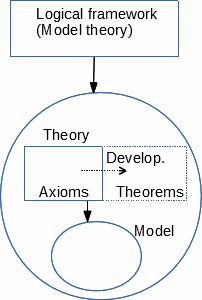
Any mathematical theory, which describes its model(s), is made of a content
and is itself described by a logical framework. The content of a theory is made
of components which are pieces of description (concepts and information we shall
describe in 1.3). A theory starts with a choice of foundation made of a
logical framework and an initial version of its content (hopefully rather small, or at
least simply describable). The components of this initial version are qualified as
primitive.
The study of the theory progresses by choosing some of its possible
developments : new components resulting from its current content
(by rules also described by the logical framework), and
that can be added to it to form its next content. These different contents, having
the same meaning (describing the essentially same models), play the role of
"different presentations of the same theory".
Any other possible development (not yet chosen) can still be added later, as the
part of the foundation that could generate it remains. Thus, the totality of
possible developments of a theory, independent of the order chosen to process
them, already forms a kind of «reality» that these developments explore.
To express the properties of its models, each theory includes a list of
statements, which are formulas meant as true when interpreted in any model.
Its primitive statements are called axioms. Further statements called theorems
are added by development to the content, under the condition that they are proven
(deduced) from previous ones : this ensures them to be true in all models,
provided that previous ones were. Theorems can then be used in further
developments in the same way as axioms.
A theory is consistent if its theorems will never contradict each other.
Inconsistent theories cannot have any model, as the same statement cannot be
true and false on the same system. The Completeness Theorem (1.9, 1.10,
4.7) will show that the
range of all possible theorems precisely fits the more interesting reality
of which statements stay true across the range of all models (which indeed exist for
any consistent theory).
Other kinds of developments (definitions and constructions) adding other
components beyond statements, will be described in 1.5, 1.D, 4.10 and 4.11.
There are possible hierarchies between theories, where some can
play a foundational role for others. For instance, the foundations of
several theories may have a common part forming a simpler theory,
whose developments are applicable to all.
A fundamental work
is to develop, from a simple initial basis, a convenient body of knowledge
to serve as a more complete "foundation", endowed with efficient tools
opening more direct ways to further interesting developments.
Platonism vs Formalism
Mathematics, or each theory, may be approached in two ways (detailed
in 1.9):
- The Platonic or realistic view, considers the mathematical realm
or some particular described systems, as preexisting realities to be explored (or
remembered, according to Plato). This is the approach of intuition which by imagining
things, smells their order before formalizing them.
- A formalistic or logicist view focuses on language, rigor
(syntactic rules) and dynamical aspects of a theory, starting
from its formal foundation, and following the rules of development.
Many philosophers of
mathematics carry obsolete conceptions of such views as forming a list of multiple
opposite beliefs (candidate truths) on the real nature of mathematics. But after
examination, just remain these two necessary and complementary views,
with diverse shares of relevance depending on topics.
By its limited abilities, human thought cannot operate in any fully
realistic way over infinite systems (or finite ones with unlimited size), but requires
some kind of logic for extrapolation, roughly equivalent to formal reasonings
developed from some foundations ; this work of formalization can prevent
possible errors of intuition. Moreover, mathematical objects cannot form any
completed totality, but only a forever temporary, expanding realm, whose precise
form is an appearance relative to a choice of formalization.
But beyond its inconvenience for expressing proofs, a purely
formalistic view cannot hold either because the clarity and self-sufficiency
of any possible foundation (starting position with formal development rules), remain
relative: any starting point had to be chosen somehow arbitrarily, taken from and
motivated by a larger perspective over mathematical realities; it must be defined in some
intuitive, presumably meaningful way, implicitly admitting its own foundation, while any
try to specify the latter would lead to a path of endless regression, whose realistic
preexistence would need to be admitted.
The cycle of foundations
The general foundation of all mathematics is itself a mathematical study, thus a
branch of mathematics, called mathematical logic. Despite the simplicity
of nature of mathematical objects, it turns out to be quite complex (though not
as bad as a physics theory of everything): by describing the general form of
theories and systems they may describe, it forms the general framework of all
branches of mathematics... including itself. So providing the foundation of each
considered foundation (unlike ordinary mathematical works that go forward from
an assumed foundation), it does not form a precise starting point, but a wide
loop composed of easier and harder steps. Still this cycle truly plays a foundational
role for mathematics, providing to its diverse branches many useful concepts
(tools, rigor, inspirations and answers to diverse philosophical questions).
(This is similar to the use of dictionaries defining each word by other words, or to this
other science of complex exact systems: computer programming. Indeed computers
can be simply used, knowing what you do but not why it works; their working
is based on software that was written in some language, then compiled by
other software, and on the hardware and processor whose design and production
were computer assisted. And this is much better in this way than at the birth of this
field.)
It is dominated by two theories:
-
Set theory describes the universe of «all mathematical
objects», from the simplest to the most complex such as infinite
systems (in a finite language). It can roughly be seen as one theory,
but in details it will have an endless diversity of possible variants
(indeed differing from each other).
-
Model theory is the study of theories (their formalisms as systems of
symbols), and systems (possible models of theories). Proof theory
completes this by describing formal systems of rules of proofs. While model theory
is usually meant as a general topic (admitting variants of concepts), it can
be specified into precise versions, thus mathematical theories called logical
frameworks, each giving a precise format of expression for a wide range
of possible theories, and (if completed by proof theory) a format in which all
proofs from any of these theories can in principle be expressed. There is an
essentially unique main logical framework called first-order logic,
by which the concepts of theory, theorem (i.e. provable statement) and
consistency of each theory, find their natural mathematical definitions;
but other logical frameworks are sometimes needed too.
Each one is the natural framework to formalize the other: each set theory is formalized
as a theory described by model theory; the latter better comes as a development from
set theory (defining theories and systems as complex objects) than directly as a theory.
Both connections must be considered separately: both roles of set theory, as a
basis and an object of study for model theory, must be distinguished. But these
formalizations will take a long work to complete.
1.2. Variables, sets, functions and operations
Starting mathematics is a matter of introducing some simple concepts from the founding
cycle, which may seem as self-sufficient as possible, while they cannot be absolutely so
(by lack of clear definitions, which would require a different start).
A usual and natural solution is to start with a set theory not fully formalized as an axiomatic
theory. This section (1.2) will intuitively introduce some first few concepts of set theory :
those of set, function and operation. But it will start by introducing some qualifications
of variables only meant as extrinsic qualities, namely to describe the status of a given variable
relatively to some kinds of contexts (viewpoints) which are not yet themselves introduced at
this stage. So here and similarly for other concepts later, the reader is invited to not be stopped by
the seeming fuzziness of the text in orange font, which will be clarified
by specific uses or other developments in later sections.
Then 1.3 will start introducing model theory, by which any theory
(and thus any set theory) can be formalized. More subtleties (paradoxes..)
in the whole picture of the foundations of mathematics will be explained later.
Constants
A constant symbol is a symbol seen as denoting a unique object,
called its value. Examples: 3, ⌀, ℕ. Those of English
language usually take the form of proper names and names with «the»
(singular without complement).
Free and bound variables
A variable symbol (or a variable), is a symbol which, instead
having an a priori definite value, comes with the concept of its possible
values, or possible interpretations, each of which give it a particular value. Each
possibility gives it a role of constant. There may be any number of these possible
values, including infinitely many, only one or even none.
It can be understood as limited by a box, whose inside has multiple
versions in parallel, articulating different viewpoints over it:
- The variable is called fixed when seen "from inside", which
means it has a given value, and is thus usable as a constant.
- It is called bound when seen from
the «outside» where the diversity of its possible values is
considered fully known, gathered and
processed as a whole. (1.8)
- It is called free to describe a coexistence of both statuses (views over it):
a local view seeing it as fixed, and an external view giving the context of its variations.
More precisely with respect to given theories, fixing a variable means taking a free
variable in a theory and more lengthily ignoring its variability, therefore simulating
the use of the other theory obtained by holding this symbol as a constant.
The diverse «internal viewpoints», corresponding to each possible value seen
as fixed, may be thought of as abstract «locations» in the mathematical universe,
while the succession of views over a symbol (qualifying it as a constant, a free
variable or a bound variable), can be seen as a first expression of the flow of time
in mathematics: a variable is bound when all the diverse "parallel locations inside
the box" (possible values) are past. All these places and
times are themselves purely abstract, mathematical entities.
Ranges and sets
The range of a variable, is the meaning it takes when seen
as bound: it is the «knowledge» of the considered totality of its possible or
authorized values (seen in bulk: unordered, ignoring their context),
that are called the elements of this range. This «knowledge» is
an abstract entity that, depending on context, may be able to
actually process (encompass) infinities of objects (unlike human thought).
Any range of a variable is called a set.
A variable has a range when it can be bound, i.e. when an encompassing view over all its
possible values is given. Not all variables of set theory will have a range. A variable without
a range can still be free, which is no more an intermediate status between fixed and bound,
but means it can take some values or some other values with no claim of exhausitivity.
Cantor defined a set as a «gathering M of definite and separate
objects of our intuition or our thought (which are called the "elements" of M) into a whole».
He explained to Dedekind : «If the totality of elements of a multiplicity can be
thought of... as "existing together", so that they can be gathered
into "one thing", I call it a consistent multiplicity or a "set".» (We expressed this
"multiplicity" as that of values of a variable).
He described the opposite case as an «inconsistent multiplicity»
where «admitting a coexistence of all its elements leads to a
contradiction». But non-contradiction cannot suffice to
generally define sets: the consistency of a statement does not
imply its truth (i.e. its negation may be true but unprovable);
facts of non-contradiction are often themselves unprovable (incompleteness theorem);
and two separately consistent coexistences might contradict each
other (Irresistible
force paradox / Omnipotence
paradox).
A variable is said to range over a set, when it is bound
with this set as its range. Any number of variables can be
introduced ranging over a given set, independently of each other and of
other variables.
Systematically renaming a bound variable in all its box, into
another symbol not used in the same context (same box), with the
same range, does not change the meaning of the whole. In practice,
the same letter can represent several separate bound variables (with
separate boxes), that can take different values without conflict, as
no two of them are anywhere free together to compare their values.
The common language does this continuously, using very few variable
symbols («he», «she», «it»...)
Functions
A function is an object f made of the following data:
- A set called the domain of f, denoted Dom
f
- For each element x of Dom f,
an object written f(x), called the image of x
by f or value of f at x.
In other words, it is an entity behaving as a variable whose value
is determined by that of another variable called its argument with
range Dom f : whenever its argument is fixed (gets a name, here
"x", and a value in Dom f), f becomes also fixed, written
f(x). This amounts to conceiving a variable f where
the "possible views" on it as fixed, are treated as objects x conceptually
distinct from the resulting values of f.
As we shall see later, such an entity (dependent variable) f would not be
(viewable as) a definite object of set theory if its argument had no range, i.e.
could not be bound (it would only be a meta-object, or object of model theory,
that we shall call a functor in 1.4)
Operations
The notion of operation generalizes that of function, by admitting a finite
list of arguments (variables with given respective ranges) instead of one. So,
an operation gives a result (a value) when all its arguments are fixed. The
number n of arguments of an operation is called its arity ; the
operation is called n-ary. It is called unary if n=1 (it is a function),
binary if n=2, ternary if n=3...
The concept of nullary operation (n=0) is superfluous, as their role is
already played by their unique value; 2.3 will show how to construct operations with arity
> 1 by means of functions.
Like for functions, the arguments of operations are basically denoted not by
symbols but by places around the operation symbol, to be filled by any
expression giving them desired values. Diverse display conventions may be used
(1.5). For instance,
using the left and right spaces in parenthesis after the symbol f, we denote
f(x,y) the value of a binary operation f on its fixed
arguments named x and y (i.e. its value when its arguments are
assigned the fixed values of x and y).
An urelement (pure element) is an object not playing any other role
than that of element: it is neither a set nor a function nor an operation.
1.3. Form of theories: notions, objects and meta-objects
The variability of the model
Each theory describes its model as a fixed system. Yet this may
be considered from some wider viewpoint as a mere «choice» of one possible model
(interpretation) in a (usually infinite) range of other possible models of
the same theory; the point of model theory is to conceive
a general definition of "models", i.e. systems which fit the given formal description by a theory (1.9).
Now this fixation of the model, like the fixation of any variable, is just the
simple act of picking any possibility, ignoring any issue of how to effectively specify an example.
Actually these «choice» and «existence» of models can be quite
abstract. In details, the proof of the Completeness
theorem will effectively «specify» a model of any consistent theory for the general case,
but this definition will not be very explicit, due to its use of infinity (4.7).
Regardless this difficulty, the attitude of implicitly fixing a model when formally studying
any mathematical theory, remains the normal way of interpreting it
(except somehow for set theory as explained in 2.A).
Notions and objects
Each theory has its own list of notions (usually designated
by common names), formally serving as the kinds of variables it can use
; each model interprets each notion as a set that is the common
range of all variables of this kind. For example, Euclidean geometry
has the notions of «point», «straight line», «circle» and more, and is usually
expressed using a different style of variable symbol for each. The
objects of a theory in a model, are all possible values
of its variables of all kinds (the elements of all its notions) in this model.
One-model theory
Any discussion on several theories T and systems M that may be
models of those T, takes place in model theory, itself a mathematical theory in
its own right with its
notions of «theory» and «system» that are the respective kinds of the variables
T and M. But when focusing on one theory with a fixed model, the
variables T and M now fixed disappear from the list of variables.
Their kinds, the notions of theory and model, disappear from the notions list too.
This reduces the framework, from some model theory, to that of a one-model theory.
A model of a one-model theory, is a system [T,M] which combines
a theory T with a model M of T.
The diversity of logical frameworks
The role of a logical
framework, as a precise version of (one-)model theory with its
proof theory, is to describe :- The admissible forms of contents for theories ;
- In particular, the syntactic structures of possible statements and other
expressions, which can be called their "grammar" ;
- The meaning of these contents and expressions on the models ;
- The rules of development of theories.
Here are those we shall see,
roughly ordered from the poorest to the most expressive
(though the order depends on the ways to relate them):
- Boolean algebra, also called propositional calculus (1.6);
- Algebra;
- First-order logic;
- Duality (for geometry) and the tensor formalism for linear algebra;
- Second-order logic (5.1, 5.2);
- Higher-order logic (5.2);
- Strong versions of set theory (1.A).
We shall first describe the main two of them in parallel. First-order logic is the
most common version of model theory, describing first-order theories we shall
also call generic theories. Set theory, which can encompass all
other theories, can also encompass logical frameworks and thus serve itself as
the ultimate logical framework as will be explained in 1.D.
Most frameworks manage notions as types (usually in finite number for
each theory) classifying both variables and objects. Notions are called types if
each object belongs to only one of them, which is then also called the type of
the variables that can name it. For example, an object of Euclidean
geometry may be either a point or a straight line, but the same
object cannot be both a point and a straight line. But set theory will need
more notions beyond types: classes, which will be introduced in 1.7.
Examples of notions from various theories
| Theory |
Kinds of objects (notions) |
| Generic theories |
Urelements classified by "types" to play different roles |
| Set theory |
Elements, sets, functions, operations,
relations, tuples... |
| Model theory |
Theories, systems and their components
(listed below) |
| One-model theory
|
Objects, symbols, types or other notions, Booleans,
structures (operators, predicates), expressions (terms, formulas)... |
| Arithmetic |
Natural numbers |
| Linear Algebra |
Vectors, scalars... |
| Geometry |
Points, straight lines, circles... |
Meta-objects
The notions of a one-model theory (1MT), normally interpreted in [T,M], classify
the components of T («type», «symbol», «formula»...), and those of M («object»,
and tools to interpret components and expressions of T there).
But the same notions (which may belong to another logical framework) can be interpreted in
[1MT, [T,M]], by putting the prefix meta- on them.
By its notion of «object», each one-model theory distinguishes the
objects of T in M from the rest of its own objects in [T,M],
which are the meta-objects. The above rule of use of the meta prefix
would let every object be a meta-object; but we will make a vocabulary
exception by only calling meta-object those which are not objects:
symbols, types or other notions, Booleans, structures, expressions...
Set theory only knows the ranges of some of its own variables, seen
as objects (sets). But, seen by one-model theory, every variable of
a theory has a range among notions, which are meta-objects only.
Components of theories
In a given logical framework, the content of a theory consists in 3
lists of components of the following kinds, where those of each of the latter
two kinds are finite systems using those of the previous kind.
- A list of abstract types, names that will designate the types in each system;
- A language (vocabulary): list of structure
symbols, names of the structures which will form the described system (1.4).
- A list of axioms chosen among expressible statements with
this language (1.9).
Set-theoretical interpretations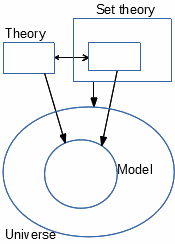
Any generic theory can be interpreted (inserted, translated) in set theory
by converting its components into components of set theory. This is the usual
view of ordinary mathematics, seeing many systems as «sets with relations or
operations such that...», with possible connections between these systems.
Let us introduce both the generic interpretations applicable to any generic
theory, and other ones usually preferred for some specific theories.
Any interpretation converts each abstract type into a symbol (name) designating
a set called interpreted type (serving as the range of variables of that type,
whose use is otherwise left intact). This symbol is usually a fixed variable in the
generic case, but can be accepted as constant symbol of set theory in special
cases such as numbers systems (ℕ, ℝ...).
In generic interpretations, all objects (elements of interpreted types) are
urelements, but other kinds of interpretations called standard
by convention for specific theories may do otherwise.
For example, standard interpretations of geometry represent points by
urelements, but represent straight lines by sets of points.
Generic interpretations will also convert structure symbols into fixed variables
(while standard ones may define them using the language of set theory).
Any choice of fixed values of all types and structure symbols, defines a choice of
system. When the language is seen
as a set (in particular if it is finite) which is usually the case, models are themselves
objects of set theory, owing
their multiplicity to the variability of types and structure symbols. This integrates
all needed theories into the same set theory, while gathering representatives
of all their considered models inside a common model of set theory. This is
why models of set theory are called universes. When adopting set
theory as our conceptual framework, this concept of "interpretation" becomes
synonymous with the choice (designation) of a model.
1.4. Structures of mathematical systems
The structures, designated in each interpretation by the structure symbols forming a
given language, form a described system by relating the objects of the diverse types, giving their
roles to the objects of each type with respect to those of other types. Depending on details, the
roles so given to objects of some types may be understood as those of complex
objects, though all this can work with bare objects like urelements.
First-order structures
The kinds of structures (and thus the kinds of structure symbols) allowed in
first-order theories, thus called first-order structures, are split into operators
and predicates as described below. More powerful structures called
second-order
structures will be introduced in 5.1, coming from set theoretical tools or as
packs of an additional type with first-order structures.
An operator is an operation between interpreted types.
On the side of the theory before interpretation, each operator symbol
comes with its symbol type made of
- its list of arguments (variable symbols figured as places
around the operator symbol instead of names),
- for each argument, its abstract type, whose value as a set will be the
range of this argument in any interpretation;
- its type of results: the type which will contain all results of the operation
designated by this symbol, in any interpretation with given values of its arguments.
In a theory with only one type, this data is reduced to the arity.
The constant symbols (or constants) of a theory
are its nullary operator symbols (having no argument).
Unary operators (that are functions) will be called here functors
(*).
The list of types is completed by the Boolean type, interpreted as the pair of elements
(the set of two elements) we shall denote 1 for «true» and 0 for «false». A variable of this
type (outside the theory) is called a Boolean variable.
A para-operator is an operator in the generalized sense allowing the
Boolean type among its types of arguments and results.
A (logical) connective is a para-operator with only Boolean arguments
and values.
A predicate is a para-operator with Boolean values, and at
least one argument but no Boolean argument.
Structures of set theory
Formalizing set theory, means describing it as a theory with its notions, structures
and axioms. We shall do this in a dedicated logical framework, different from
but convertible into first-order logic by a procedure described in 2.1.
This relates the terminologies of set theory and one-model theory
in a different way than when a theory is interpreted in set theory. To keep the
natural names of set theoretical notions (sets, functions...) when defined by
this formalization, it would become incorrect to still use them in the sense of
the previous link (where notions were "sets" and
operators were "operations"). To avoid confusion, let us here only use the model theoretical
notions as our conceptual framework, ignoring their set theoretical interpretations.
Ways to put both links together, and to reconcile both conceptions of the same
theories (descriptions by model theory and interpretations in set theory) will
be described in 1.7 and 1.D.
Let us admit 3 primitive notions : elements (all objects), sets and functions. Here are
their main primitive structures.
One aspect of the role of sets is given by the binary
predicate ∈ of belonging or membership : for any element x and
any set E, we say that x is in E (or x belongs to E, or
x is an element of E, or E contains x) and write x ∈
E, to mean that x is a possible value of the variables with range E.
Functions f play their role by two operators: the domain functor Dom,
and the function evaluator, binary operator that is implicit in the notation
f(x), with arguments f and x, giving the value of any
function f at any element x of Dom f.
More primitive symbols
will be presented in 1.7 and 1.8, then most other primitive symbols and axioms
will be introduced in 1.A, 2.1, 2.2 and 2.7.
About ZFC set theory
The Zermelo-Fraenkel set theory (ZF, or ZFC with the axiom of choice)
is a generic theory with only one type «set», one structure symbol ∈ ,
and axioms. It implicitly assumes that every object is a set, and thus a set
of sets and so on, built over the empty set.
As a rather simply expressible
but very powerful set theory for an enlarged founding cycle, it can be a good
choice indeed for specialists of mathematical logic to conveniently prove diverse
difficult foundational theorems, such as the unprovability of some statements,
while giving them a scope that is arguably among the best conceivable ones.
But despite the habit of authors of basic math courses to conceive their
presentation of set theory as a popularized or implicit version of ZF(C), it is
actually not an ideal reference for a start of mathematics for beginners:
- It cannot be self-contained as it must assume the framework of model theory to
make sense.
- Its axioms, usually just admitted (as either intuitive,
obvious, necessary or just historically selected for their consistency and the
convenience of their consequences), would actually deserve more subtle and
complex justifications, which cannot find place at a starting point of mathematics.
- Ordinary mathematics, using many objects usually not seen as sets,
are only inelegantly developed from this basis. As the roles of all needed
objects can anyway be indirectly played by sets, they did not require another
formalization, but remained cases of discrepancy between the
«theory» and the practice of mathematics.
The complexity and weirdness of these needed developments
do not disturb specialists just because once known possible, they
can simply be taken for granted.
Formalizing types and structures as objects of one-model theory
To formalize one-model theory through the use of the meta- prefix,
both meta-notions of "types" and "structures" are given their roles by
meta-structures as follows.
Since one-model theory assumes a fixed model, it only needs one
meta-type of "types" to play both roles of abstracts types (in the theory)
and interpreted types (components of the model), respectively given by
two meta-functors: one from variables to types, and one from objects
to types. Indeed the more general notion of «set of objects» is not used
and can be ignored.
But the meta-notion of structure will have to remain distinct from the language,
because more structures beyond those named in the language will be involved (1.5).
Structures will get their roles as operations, from meta-structures similar to
the function evaluator (see 3.2-3.3 for clues), while the
language (set of structure symbols) will be interpreted there by a meta-functor from
structure symbols to structures.
However, this mere formalization would leave
undetermined the range of this notion of structure. Trying to conceive this range as that of
«all operations between interpreted types» would leave unknown the source
of knowledge of such a totality. This idea of totality will be formalized in set
theory as the powerset (2.7), but its meaning will still depend on the
universe where it is interpreted, far from our present concern for one-model theory.
1.5. Expressions and definable structures
Terms and formulas
Given the first two layers of a theory (a list of types and a language), an
expression is a finite system of occurrences of symbols, where,
intuitively speaking, an occurrence of a symbol in an expression
is a place where that symbol is written (more details later).
Each expression comes in the context of a given list of available free
variables. Any expression will give (define) a value (either an object
or a Boolean) for each possible data of
- A system interpreting the given types and structure symbols;
- Fixed values of available free variables in this system.
The type of an expression, determined by its syntax as described below,
gives the type of all its possible values. Expressions with Boolean type are called
formulas; others, whose type belongs to the given types list
(their values will be objects), are called terms.
For example, « x+x » is a term with two occurrences
of the variable «x», and one of the addition symbol «+».
The diverse kinds of symbols
In expressions of first-order theories and set theory, symbols of the following kinds may occur.
- Variables of each type:
- Free variables, from the list of available ones ;
- Bound variables, whose occurrences are contained by binders (see 1.8) ;
- Para-operator
symbols:
- Structure symbols from the language (operators and predicates) ;
- One equality symbol per type (predicate with 2 arguments of
the same type) abusively all written = ;
- Logical connectives (1.4, listed in 1.6) ;
-
The conditional operator may
be introduced for abbreviation (2.4).
- Binders (1.8):
- Quantifiers
∀ and ∃ (1.10) are the only primitive binders of first-order logic ;
- More binders will be introduced in set theory.
In first-order logic, let us call logical symbols the quantifiers and symbols of
para-operators outside the language (equality, connectives and conditional operator):
their list and their meaning in each system are determined by the logical framework and
the given types list, which is why they are not listed as components of individual theories.
Root and sub-expressions
Each expression contains a special occurrence of a symbol called its root,
while each other occurrence of a symbol there, is the root of a unique sub-expression
(another expression contained in the given one, and which we may call the sub-expression
of that occurrence).
The type of an expression is given
by the type of result of
its root.
Expressions are built successively, in parallel between different lists of available free variables.
The first and simplest ones are made of just one symbol (as root, having a value by
itself) : constants and variables are the first terms; the
Boolean constants 1 and 0 are the simplest formulas.
The next expressions are then successively built as made of the
following data:
- A choice of root, occurrence of either a para-operator symbol (beyond constants
we already mentioned) or a binder;
- If the root is a binder: a choice of variable symbol, to be bound by it;
- A list of previously built expressions, whose format (number and
types of entries) is determined by the root : for a
para-operator symbol, this format is given by its list of its arguments.
An algebraic term is a term with only free variables and operator symbols ;
these are the only terms in first-order logic without conditional operator.
This notion for only one type, will be formalized as a kind of system in set theory in 4.1.
Display conventions
The display of this list of sub-expressions directly attached to the root requires a
choice of convention. For a para-operator symbol other than constants :
- Most binary para-operator symbols are displayed as one
character between (separating) both arguments, such as in x+y
- Symbols with higher arities can be similarly displayed by
several characters separating the entries, such as in the addition
x+y+z of 3 numbers.
- Function-like displays, such as +(x,y) instead of
x+y, are more usual for arities other than 2 ;
parenthesis may be omitted when arities are known (Polish notation).
-
A few symbols «appear» only implicitly by their special way of putting
their arguments together : multiplication in xy, exponentiation in
xn.
-
Parenthesis can be part of the notation of a
symbol (function evaluator, tuples...).
Parenthesis can also be used to distinguish (separate) the subexpressions, thus
distinguish the root of each expression from other occurring symbols. For example
the root of (x+y)n is the exponentiation operator.
Variable structures
Usually, only few objects are named by the constants in a given language.
Any other objects can be named by a fixed variable, whose status
depends on the choice of theory to see it:
- An ordinary variable symbol, usable by expressions which by a binder
can let it range over some notion;
- A new constant symbol, to be added to the language, forming another
theory with a richer language.
The difference vanishes in generic interpretations which turn
constant symbols into variables (whose values define different models).
By similarity to constants which are particular structures (nullary operators),
the concept of variable can be generalized to that of variable structure.
But those beyond nullary operations (ordinary variables) escape the above list
of allowed symbols in expressions. Still some specific kinds of use of variable
structure symbols can be justified as abbreviations (indirect descriptions)
of the use of legitimate expressions. The main case of this is explained below ;
another use (looking similar but actually a meta-variable)
will be involved in 1.10.
Structures defined by expressions
Starting with any theory, one can introduce a kind of symbol of variable
structure (operator or predicate, though a nullary predicate is normally called a
"Boolean" rather than a "structure"), defined by the following data
it means to abbreviate:
- An expression (terms define operators, while formulas define predicates
and Booleans);
- Among its available free variables, a selection of those which will be bound
by this definition in the role of arguments of the intended structure;
the rest of them, which remain free, are called parameters.
Each of its possible values as a structure or a Boolean comes by fixing the values of all
parameters. So, its variation somehow abbreviates those of all parameters.
Any theory can be extended by the construction of a new notion (abstract type)
given as the range of a variable structure defined by a given (fixed)
expression, while its parameters range over all possible combinations of values.
This is our first case of a construction rule (kind of development of a theory).
The full review of construction rules will be done in 4.11.
In set theory, any function f is synonymous with the functor defined by the term
f(x) with argument x and parameter f (but the domain of this
functor is Dom f instead of a type).
The terms without argument define simple objects (nullary operators) ; the one made
of a variable of a given type, seen as parameter, suffices to give all objects of its type.
Now let us declare the meta-notion of "structure" in one-model theory,
and thus those of "operator" and "predicate", as having to include at least all those
reachable in this way: defined by any expression with any possible values of
parameters. The minimal version of such a meta-notion can be formalized as a
role given to the range of all combinations of an expression with fixed values of its
parameters. As this involves the infinite set of all expressions, this meta-notion usually
escapes (is inaccessible by) the described theory itself : no fixed expression can suffice
to simulate it. Still when interpreting this in set theory, more operations between
interpreted types (undefinable ones) usually exist in the universe. Among the few
exceptions, the full set theoretical range of a variable structure with all
arguments ranging over finite sets (as interpreted types) with given size
limits, can be reached by one expression whose size depends on these limits.
Invariant structures
An invariant structure of a given system (interpreted language), is a
structure defined from its language without parameters (thus a constant one).
This distinction of invariant structures from other structures, generalizes
the distinction between constants and variables, both to cases of
nonzero arity, and to what can be defined by expressions instead of
directly named in the language. Indeed any structure named by a symbol
in the language is directly defined by it without parameter, and thus invariant.
As will be further discussed in 4.10, theories can be developed by definitions,
which consists in naming another invariant structure by a new symbol added to
the language. Among aspects of the preserved meaning of the theory,
are the meta-notions of structure, invariant structure, and the range of theorems
expressible with the previous language.
1.6. Logical connectives
We defined earlier the concept of
logical connective. Let us now list the main useful ones, beyond both nullary ones
(Boolean constants) 1 and 0. (To this will be added
the conditional connective in 2.4).
Tautologies
Their properties will be expressed by tautologies, which are formulas only
involving connectives and Boolean
variables (here written A, B, C), and true for all possible
combinations of values of these variables.
So, they also give necessarily true formulas when replacing these variables by any defining formulas using any
language and interpreted in any systems. Such definitions of Boolean variables by
formulas of a theory may restrict their ranges of possible values depending on each other.
Tautologies form the rules of Boolean algebra, an algebraic theory describing
operations on the Boolean type, itself naturally interpreted as the pair of elements 0 and 1
(but also admitting more sophisticated interpretations beyond the scope of this chapter).
The binary connective of equality between Booleans is written ⇔ and
called equivalence: A ⇔ B is read «A
is equivalent to B».
Negation
The only useful unary connective is the negation ¬, that
exchanges Booleans (¬A is read «not A»):
It is often denoted by barring the root of its argument, forming
with it another symbol with the same format:
x ≠ y
x ∉ E
(A ⇎ B)
|
⇔ ¬(x = y)
⇔ ¬(x ∈ E)
⇔ (A ⇔ ¬B)
|
(x is not equal to y)
(x is not an element of E)
(inequivalence) |
Conjunctions, disjunctions
The conjunction ∧ means «and», being true only when both
arguments are true;
The disjunction ∨ means «or», being true except when both
arguments are false.
Each of them is :
Idempotent
(A ∧ A) ⇔ A
(A ∨ A) ⇔ A
|
Commutative
(B∧A) ⇔ (A∧B)
(B∨A) ⇔ (A∨B)
|
Associative
((A∧B)∧C) ⇔ (A∧(B∧C))
((A∨B)∨C) ⇔ (A∨(B∨C))
|
Distributive over the other
(A ∧ (B∨C)) ⇔ ((A∧B)
∨ (A∧C))
(A ∨ (B∧C)) ⇔ ((A∨B)
∧ (A∨C))
|
This similarity (symmetry) of their properties comes from the fact they are
exchanged by negation:
(A ∨ B)
⇎ (¬A ∧ ¬B)
(A ∧ B) ⇎ (¬A ∨ ¬B)
The inequivalence is
also called exclusive or because (A
⇎ B) ⇔ ((A ∨ B) ∧ ¬(A
∧ B)).
Chains of conjunctions such as (A ∧ B ∧ C),
abbreviate any formula with more parenthesis such as ((A ∧ B)
∧ C), all equivalent by
associativity ; similarly for chains of disjunctions such as (A
∨ B ∨ C).
Asserting (declaring as true) a conjunction of formulas amounts to successively
asserting all these formulas.
Implication
The binary connective of implication ⇒ is defined as (A ⇒ B) ⇔ ((¬A)
∨ B). It can be read «A implies B», «A
is a sufficient condition for B», or «B is a
necessary condition for A». Being true except when A
is true and B is false, it expresses the truth of B
when A is true, but no more gives information on B
when A is false (as it is then true).
Moreover,
(A ⇒ B) ⇎
(A ⇒ B) ⇔ |
(A ∧ ¬B)
(¬B ⇒ ¬A) |
The formula ¬B ⇒ ¬A is called the contrapositive
of A ⇒ B.
The equivalence can also be redefined as
(A ⇔ B) ⇔ ((A ⇒ B) ∧ (B ⇒ A)).
Thus in a given theory, a proof of A ⇔ B can be
formed of a proof of the first implication (A ⇒ B), then a
proof of the second one (B ⇒ A), called the converse of (A
⇒ B).
The formula A ∧ (A ⇒ B) is equivalent to A ∧ B
but will be written A ∴ B, which reads «A therefore B», to
indicate that it is deduced from the truths of A and A ⇒ B.
Negations turn the associativity and distributivity of ∧ and ∨, into various
tautologies involving implications:
(A ⇒ (B ⇒ C)) ⇔ ((A ∧ B) ⇒ C)
(A ⇒ (B ∨ C))
⇔ ((A ⇒ B) ∨ C)
(A ⇒ (B ∧ C)) ⇔ ((A ⇒ B) ∧ (A ⇒ C))
((A ∨ B) ⇒ C) ⇔
((A ⇒ C) ∧ (B ⇒ C))
((A ⇒ B) ⇒ C) ⇔
((A ∨ C) ∧ (B ⇒ C))
(A ∧ (B ⇒ C)) ⇔
((A ⇒ B) ⇒ (A ∧ C))
Finally, (A ⇒ B)
⇒ ((A∧C) ⇒ (B∧C))
(A ⇒ B) ⇒
((A∨C) ⇒ (B∨C)).
Chains of implications and equivalences
In a different kind of abbreviation, any chain of formulas
linked by ⇔ and/or ⇒ will mean the chain of conjunctions of these
implications or equivalences between adjacent formulas:
(A ⇒ B
⇒ C) ⇔ ((A ⇒ B) ∧ (B ⇒ C)) ⇒
(A ⇒ C)
(A ⇔ B ⇔ C) ⇔ ((A ⇔ B) ∧ (B
⇔ C)) ⇒ (A ⇔ C)
0 ⇒ A ⇒ A ⇒ 1
(¬A) ⇔ (A ⇒ 0) ⇔ (A ⇔ 0)
(A ∧ 1) ⇔ A ⇔ (A ∨ 0) ⇔ (1 ⇒ A) ⇔ (A
⇔ 1)
(A ∧ B) ⇒ A ⇒ (A ∨ B)
1.7. Classes in set theory
In any system, a class is a unary
predicate A seen as the set of objects where A is true, that is «the
class of all x such that A(x)».
In a set theoretical universe,
each set E is synonymous with the class of the x such that x∈E
(defined by the formula x∈E with argument x and parameter E).
However, this involves two different interpretations of the notion of set,
that need to be distinguished as follows.
Standard universes and meta-sets
Interpreting (inserting)
set theory into itself, involves articulating two interpretations (models) of set theory, which
will be distinguished by giving the meta- prefix to the one used as framework. Aside generic
interpretations, set theory has a standard kind of interpretations into itself, where each
set is interpreted by the class (meta-set) of its elements (the synonymous set and
meta-set, i.e. with the same elements, are now equal), and each function is interpreted
by its synonymous meta-function.
This way, any set will be a class, while any class is a meta-set of objects. But some
meta-sets of objects are not classes (no formula with parameters can define them ;
giving examples would be paradoxical as it would mean defining something
undefinable, yet 1.B
introduces such possibilities);
and some classes are not sets, such as the class of all sets (see Russell's
paradox in 1.8), and the universe (class of all objects, defined by 1).
Definiteness classes
Set theory accepts all objects as «elements» that can belong to sets and be
operated by functions (to avoid endless further divisions between sets of
elements, sets of sets, sets of functions, mixed sets...). This might be formalized
keeping 3 types (elements, sets and functions), where each set would have a
copy as element, identified by a functor from sets to elements, and the same for
functions. But beyond these types, our set theory will anyway need more
notions as domains of its structures, which can only be conveniently formalized
as classes. So, let us keep "element" as the only type containing all objects, and
formalize the notions of set and function as classes named by predicate symbols:
Set = «is a set»
Fnc = «is a function»
In first-order logic, any expression is ensured to take a definite value, for
every data of a model and values of all free variables there (by virtue of its
syntactic correction, that is implicit in the concept of «expression»).
But in set theory, this may still depend on the values of free variables.
So, an expression A (and any structure defined from it) will be called
definite, if it actually takes a value for the given values of its free variables
(seen as arguments and parameters of any structure it defines). This condition
is itself an everywhere definite
predicate, expressed by a formula dA with the same free variables.
Choosing one of these as argument, the class it defines is the meta-domain,
called class of definiteness, of the unary structure defined by A.
Expressions should be only used where they are definite, which will be done
rather naturally. The definiteness condition of (x ∈ E) is Set(E).
That of the function evaluator f(x) is Fnc(f) ∧
x ∈ Dom f.
But the definiteness of the last formula needs a justification, given below.
Extended definiteness
A theory with partially definite structures, like set theory, can be formalized (translated) as
a theory with one type and everywhere definite structures, keeping intact all expressions
and their values wherever they are definite : models are translated one way by giving
arbitrary values to indefinite structures (e.g. a constant value), and in the way back by
ignoring those values. Thus, an expression with an indefinite subexpression may be
declared definite if its final value does not depend on these extra values.
In particular for any formulas A and B, we shall regard the formulas
A ∧ B and A ⇒ B as definite if A
is false, with respective values 0 and 1, even if B is not definite. So,
let us give them the same definiteness condition
dA ∧ (A ⇒ dB)
(breaking, for A ∧ B, the symmetry between A
and B, that needs not be restored). This formula is made definite by the
same rule provided that dA and dB were definite. This way, both formulas
A ∧ (B ∧ C)
(A ∧ B) ∧ C
have the same definiteness condition (dA ∧
(A ⇒ (dB ∧ (B ⇒ dC)))).
Classes will be defined by everywhere definite predicates, easily expressible by
the above rule as follows.
Any predicate A can be extended beyond its
domain of definiteness, in the form dA ∧ A (giving 0), or
dA ⇒ A (giving 1).
For any class A and any unary predicate B definite in all A, the class defined
by A∧B is called the subclass of A
defined by B.
1.8. Binders in set theory
The syntax of binders
This last kind of symbol can form
an expression by taking a variable symbol, say here x, and an
expression F which may use x as a free variable (in addition to the free
variables that are available outside), to give a value depending on the unary structure
defined by F with argument x. Thus, it separates the «inside»
subexpression F having x among its free variables, from the «outside»
where x is bound. But in most cases (in most theories...),
binders cannot keep the full information on this unary structure, which is too complex
to be recorded as an object as we shall see below.
We shall first review both main binders of set theory : the set-builder and the function
definer. Then 1.10 will present both main quantifiers. Finally 2.1 and 2.2 will give
axioms to complete this formalization of the notions of sets and functions in set theory.
The syntax differs between first-order logic and set theory, which manage the
ranges of variables differently. In first-order logic, ranges are types,
implicit data of quantifiers. But the ranges of binders of set theory are sets
which, as objects, are designated by an additional argument of the binder
(a space for a term not using the variable being bound).
Set-builder
For any unary predicate A definite on all elements of a set E, the
subclass
of E defined by A is a set : it is the range of a
variable x introduced as ranging over E, so that it
can be bound, from which we select the values satisfying
A(x). It is thus a subset of E, written
{x∈E | A(x)} (set of all x
in E such that A(x)): for all y,
y ∈ {x∈E | A(x)}
⇔ (y ∈ E ∧ A(y))
This combination of characters { ∈ | } forms the notation of a binder
named the set-builder: {x∈E | A(x)}
binds x with range E on the formula A.
Russell's paradox
If the universe (class of all elements) was a set then, using it, the set
builder could turn all other classes, such as the class of all sets, into sets.
But this is impossible as can be proven using the set-builder itself :
Theorem. For any set E there is a set F
such that F ∉ E. So, no set E can contains all sets.
Proof. F = {x∈E | Set(x) ∧ x ∉ x}
⇒ (F ∈ F ⇔ (F ∈ E ∧ F ∉ F))
⇒ (F ∉ F ∧ F ∉ E). ∎
This will oblige us to keep the distinctions between sets and
classes.
The function definer
The function definer ( ∋ ↦ ) binds a variable on a term,
following the syntax E ∋ x ↦ t(x),
where - x is the variable,
- E is its range,
- the notation
"t(x)" stands for any term, here abbreviated (to describe
the general case) using the functor symbol t defined by this term with
argument x (and possible parameters here kept implicit).
Being definite if t(x) is definite for all x in E,
it takes then the functor t and restricts its domain (definiteness class) to the
set E, to give a function with domain E. So it converts functors into
functions, reversing the action of the function evaluator (with the Dom functor)
that converted (interpreted) functions into their role (meaning) as functors
whose definiteness classes were sets.
The shorter notation x ↦ t(x) may be used when
E is determined by the context, or in a meta description to designate a
functor by specifying the argument x of its defining term.
Relations
A relation is a role playing object of set theory similar to an operation
but with Boolean values : it acts as a predicate whose definiteness
classes (ranges of arguments) are sets (so, predicates could be
described as relations between interpreted types). Now unary relations
(functions with Boolean values), will be represented as subsets S
of their domain E, using the set-builder in the role of definer, and ∈
in the role of evaluator interpreting S as the predicate
x ↦ (x ∈ S).
This role of S still differs from the intended unary relation, as it ignores its domain
E but is definite in the whole universe, giving 0 outside E.
This lack of operator Dom does not matter, as E is usually known
from the context (as an available variable).
As the function definer (resp. the set-builder) records the whole
structure defined by the given expression on the given set, it
suffices to define any other binder of set theory
on the same expression with the
same domain, as made of a unary structure applied to its
result (that is a function, resp. a set).
1.9. Axioms and proofs
Statements
An expression is ground if its list of available free variables is empty (all its variables
are bound), so that its value only depends on the system where it is interpreted.
In first-order logic, a statement is a ground formula. Thus, a statement A
will have a definite Boolean value only depending on the choice of a system M
that interprets its language. We denote M⊨A the truth of A in M.
The axioms list of a theory is a set of statements, meant to be all true in some
given system(s) called models of the theory. Let us explain.
Realistic vs. axiomatic theories in mathematics and other sciences
Apart from the distinction
of nature (mathematical vs. non-mathematical), theories may also differ by
the intention of their use, between realism and formalism.
An axiomatic theory is a formally given theory T = (τ, L, X)
with an axioms list X, that means to define the class of its models, as
that of all systems M interpreting the language L where all axioms
(elements of X) are true, which will be denoted M⊨T.
A realistic theory is a theory involved to describe either a fixed or
a variable system, i.e. a class of systems, seen as given from some independent reality.
Its given axioms are statements which, for some reason, are considered known as true
on all these systems. Such a theory is true if all its axioms are indeed true there.
In this case, these systems are models, qualified as standard for contrast with
other (unintended) models of that theory taken axiomatically.
This truth will usually be ensured for realistic theories of pure mathematics : arithmetic
and set theory (though the realistic meaning of set theory will not always be clear
depending on considered axioms). These theories will also admit non-standard
models, making their realistic and axiomatic meanings effectively differ.
Outside pure mathematics, the truth of realistic theories may be dubious
(questionable): non-mathematical statements over non-mathematical systems
may be ambiguous (ill-defined), while the truth of theories of applied mathematics
may be approximative, or speculative as the intended "real" systems may be
unknown (contingent among other possible ones). There, a theory is called
falsifiable if, in principle, the case
of its falsity can be discovered by comparing its predictions (theorems) with
observations. For example, biology is relative to a huge number of random
choices silently accumulated by Nature on Earth during billions of years ; it has
lots of "axioms" which are falsifiable and require a lot of empirical testing.
Non-realistic theories outside mathematics (not called "axiomatic" by lack of mathematical
precision) would be works of fiction describing imaginary or possible future systems.
Euclidean geometry was first conceived as a realistic theory of applied mathematics
(for its role of first theory of physics),
then became understood as an axiomatic theory of pure mathematics among diverse
other, equally legitimate geometries in a mathematical sense; while the real physical
space is more accurately described by the non-Euclidean geometry of General Relativity.
Provability
A proof of a statement A in a theory T, is a finite model of a
one-proof theory (reduction of proof theory to the description of a single proof),
having A as "conclusion" and involving a finite list of axioms among those of T.
Suitable full formalizations of the concept of proof for first-order logic could be found by
specialists. Those can take the form of formalized (one-)proof theories (as axiomatic theories),
or proof verification algorithms (only requiring an amount of computing resources related
to the size of a given proof).
But most
mathematical works are only partially formalized : semi-formal proofs are used with just enough
rigor to give the feeling that a full formalization is possible, without actually writing it ; an intuitive
vision of a problem may seem clearer than a formal reasoning. Likewise, this work will present proofs
naturally without explicit full formalization : sometimes using natural language articulations,
proofs will mainly be written as successions of statements each visibly true thanks to
previous ones, premises, axioms, known theorems and rules of proof, especially those of
quantifiers (1.10). End of proof is
marked by "∎".
Yet without giving details of any proof theory, let us review some general properties.
We say that A is provable in T, or a theorem of T, and
write T ⊢ A if a proof of A in T exists. In practice,
we only qualify as theorems the statements known as such, i.e. for which a proof is known.
But synonyms for "theorem" are traditionally used according to their importance: a theorem
is more important than a proposition; either of them may be deduced from an
otherwise less important lemma, and easily implies an also less important corollary.
Any good proof theory needs of course to be sound, which means only "proving" always true
statements : provability implies truth in every model (where all axioms are true).
Logical validity
For a given language L, a statement A
is called logically valid if it is provable with L, without using any axiom.
This might be written ⊢ A but for
full accuracy it needs to be written L ⊢ A (meaning that A is theorem of the
theory made of L without axiom, thus of any other theory containing L). Then A
is true in every system interpreting L, thanks to the soundness of the logical framework.
The simplest logically valid statements are the tautologies
(whose Boolean variables are replaced by statements); others will be given in 1.10.
A proof of A using some axioms can also be seen as a proof of (conjunction of these axioms
⇒ A) without axiom, thus making this implication logically valid.
Refutability and consistency
A refutation of A in T, is a proof of ¬A. If one exists
(T ⊢ ¬A), the statement A is called refutable (in T).
A statement is called decidable (in T) if it is provable or refutable.
A contradiction of a theory T is a proof of 0 in T. If one exists
(T ⊢ 0), the theory T is called contradictory or inconsistent ;
otherwise it is called consistent.
A refutation of A in T amounts to a contradiction of the theory
T∧A obtained by adding A to the axioms of T.
If a statement is both provable and refutable in T then all are, because
it means that T is inconsistent, independently of the chosen statement:
⊢ (A ∧ ¬A) ⇔ 0
((T ⊢ A) ∧ (T ⊢ B)) ⇔ (T ⊢ A∧B)
((T ⊢ A) ∧ (T ⊢ ¬A)) ⇔ (T ⊢ 0).
So a contradiction can be presented as a proof of A with a refutation of A.
In an inconsistent theory, every statement is provable. Its framework being sound,
such a theory has no model.
Beyond the required quality of soundness of the proof theoretical part of a logical framework,
more remarkable is its converse quality of completeness : that for any axiomatic theory
it describes, any statement that is true in all models is provable. In other words, any unprovable
statement is false somewhere, and any irrefutable statement is true somewhere. Thus, any
consistent theory has existing models, but often a diversity of them, as any undecidable
statement is true in some and false in others. Adding some chosen undecidable statements
to axioms leads to different consistent theories which can «disagree» without conflict, all
truly describing different existing systems. This resolves much of a priori divergence between
Platonism and formalism
while giving proper mathematical definiteness to the a priori intuitive concepts of "proof",
"theorem" and "consistency".
1.10. Quantifiers
A quantifier is a binder
taking a unary predicate (formula) and giving a Boolean value.
Bounded vs open quantifiers
A quantifier Q is called bounded when following
the use format for binders in set
theory (1.8) : its range is a set given as an argument. For quantifiers this format is written
(Q ∈ , ) filled as (Qx∈E, A(x)) to take as input a unary
predicate A, by binding a variable x with range E on any formula here
abbreviated as A(x) to mean it defines A with argument x and possible
parameters.
Primitively in first-order logic, the ranges of quantifiers are types (the same type as the bound
variable, not formally an argument). Any range E (type, class or set) may
be marked as an index (QEx, A(x)), or deleted altogether
(Qx, A(x)) when it is unimportant or implicit as fixed by the context.
When set theory is formalized in first-order logic, the quantifiers from first-order logic,
ranging over the universe, and their variants ranging over classes (defined from them
below), are called open quantifiers to be distinguished from the restricted case
of bounded quantifiers (as sets are there
particular cases of classes).
In this context, a formula is qualified as bounded if all its quantifiers are bounded.
Only these formulas will be accepted for some uses (1.A, 1.C, 2.1, 2.2).
Both main quantifiers
There are two main quantifiers (from which others will be defined in 2.4):
- The universal quantifier ∀ means «for all»: (∀x∈E, A(x)) is read
«For all x in E, A(x)».
-
The existential quantifier ∃ means «there exists»: (∃x∈E,
A(x)) is read «There exists x in E such that A(x)».
The bounded universal quantifier is definable from the set builder:
(∀x∈E, A(x)) ⇔ {x∈E
| A(x)} = E.
Quantifiers with any range can be defined in interpretations,
seeing A as a function
and its Boolean values as objects:
(∀x, A(x)) ⇔ A = (x ↦ 1)
(∃x, A(x)) ⇔ A ≠ (x ↦ 0)
(∃x, A(x)) ⇎ (∀x, ¬A(x))
(∀x, 1) is always true.
Quantifiers over classes can be defined as
(∀C x, A(x)) ⇔ (∀x, C(x) ⇒
A(x))
(∃C x, A(x)) ⇔ (∃x, C(x) ∧ A(x))
⇔ ∃C∧A x, 1
Inversely any class is definable from a quantifier over it : ∀x, (C(x)
⇔ ∃C y, x=y).
Inclusion between classes
A class A is said to be included in a class
B when ∀x, A(x) ⇒ B(x). Then
A is a
subclass of B, as ∀x, A(x) ⇔ (B(x)
∧ A(x)). Conversely, any subclass of B is
included in B.
The inclusion of A in B
implies for any predicate C (in cases of definiteness):
(∀B
x, C(x)) ⇒ (∀A x,
C(x))
(∃A x, C(x)) ⇒ (∃B
x, C(x))
(∃C x, A(x)) ⇒ (∃C
x, B(x))
(∀C x, A(x)) ⇒ (∀C
x, B(x))
Rules of proofs for quantifiers on a unary predicate
Just like expressions were described by allowing to take already made expressions
to form new ones, the concept of proof may be formalized by using already known proofs
to form new ones. Here are some intuitively introduced rules, still without claim of full formalization.
Existential Introduction. If we have terms t,
t′,… and a proof of (A(t) ∨ A(t′)
∨ …), then ∃x, A(x).
Existential Elimination. If ∃x, A(x),
then we can introduce a new free variable z with the
hypothesis A(z) (the consequences will be
true without restricting the generality).
These rules express the meaning of ∃ : going from some term to ∃ then from ∃ to z,
amounts to letting z represent that term (without knowing which, but they can be gathered
into one by the conditional operator).
They give the same meaning to ∃C as to its 2 above equivalent formulas,
bypassing (making implicit) the extended definiteness rule for (C ∧ A) by focusing
on the case when C(x) is true and thus A(x) is definite.
While ∃ appeared as the designation of an object, ∀ appears as a
deduction rule: ∀C x, A(x)
means that its negation ∃C x, ¬A(x)
leads to a contradiction.
Universal Introduction. If from the mere hypothesis C(x)
on a new free variable x we could deduce A(x),
then ∀C x, A(x).
Universal Elimination. If ∀C x,
A(x) and t is a term satisfying C(t),
then A(t).
Introducing then eliminating ∀ is like replacing x by t
in the initial proof. Some logically valid formulas
The above rules can be used to justify the following logically valid formulas
((∀C x, A(x))
∧ (∀C x, A(x) ⇒ B(x)))
⇒ (∀C x, B(x))
((∃C x, A(x))
∧ (∀C x, A(x) ⇒ B(x)))
⇒ (∃C x, B(x))
((∀C x, A(x))
∧ (∃C x, B(x))) ⇒
(∃C x, A(x) ∧
B(x))
(∀C x,
A(x)∨B(x)) ⇒ ((∀C x,
A(x)) ∨ (∃C x,
B(x)))
(∀A x, ∀B
y, R(x,y)) ⇔ (∀B y,
∀A x, R(x,y))
(∃A x, ∃B
y, R(x,y)) ⇔ (∃B y,
∃A x, R(x,y))
(∃A x, ∀B
y, R(x,y)) ⇒ (∀B y,
∃A x, R(x,y))
∀x, (∀y, R(x,y)) ⇒
R(x,x) ⇒ (∃y, R(x,y))
We shall use the following abbreviations, also similarly with bounded quantifiers:
- (∀C x,y, ) means (∀C x, ∀C
y, ) and so on for more variables with the same range.
- (∃C x,y, ) means (∃C x, ∃C
y, ) (same remark).
- (∀C x≠y, ) means (∀C x,y, x≠y ⇒ )
- (∃C x≠y, ) means (∃C x,y, x≠y ∧ )
- (∃C x, A(x) ∴
B(x)) means (∃C x, A(x)) ∧
(∀C x, A(x) ⇒ B(x)),
while it implies but is not always equivalent to
(∃C x, A(x) ∧ B(x)).
Logical
validity depends on language because, with only one type
(L ⊢ ∃x, 1) ⇔ (a constant symbol exists in L)
(With more types the condition is more complicated; but as most useful theories require all types to be
nonempty, the dependence on language may be ignored in practice)
Completeness of first-order logic
First-order logic was found complete
as expressed by the completeness
theorem, which was originally Gödel's
thesis : from a suitably formalized concept of «proof», the resulting class of (potential)
theorems A of any first-order theory T was found to be the "perfect" one, coinciding
with the class of universally true statements (true in all models M):
∀A, (T ⊢ A) ⇔ (∀M, (M⊨T)⇒(M⊨A))
Such a proof theory for first-order
logic is essentially unique: the equivalence between any two sound and complete proof
theories as concerns the existence of a proof of a statement in a theory, concretely
appears by the possibility to translate any "proof" for the one into a "proof" for the other.
This quality of first-order logic confirms its central importance in the foundations of
mathematics, after its ability to express all mathematics : any logical
framework can anyway be developed from set theory (and more directly, any theory from
any framework can be somehow interpreted in set theory), itself expressible as a first-order theory.
The proof of the completeness theorem, which requires the axiom of infinity (existence
of ℕ) will consist in building a model of any consistent first-order axiomatic theory, as follows
(details in 4.6). The (infinite) set of all ground terms with operator symbols derived from the theory
(those of its language plus others coming from its existence axioms), is turned into a model
by progressively defining each predicate symbol over each combination of values of its
arguments there, by a rule designed to keep consistency.
This construction is non-algorithmic : it is made of an infinity of steps, where each step may involve
an infinite knowledge (of whether the given predicate on given arguments, seen as a candidate
additional axiom, preserves consistency with previously accepted ones).
Actually, most foundational theories such as set theories,
do not have any algorithmically definable model.
1.11. Second-order universal quantifiers
First-order logic can be developed to allow the use of variable structure symbols as
abbreviations of fixed expressions defining these structures with variable parameters, but
this way can only bind them on some restricted ranges depending on the chosen expressions
(more comments in 1.D).
Now let us
call second-order quantifier, a quantifier binding a variable structure symbol over the
range of all structures of its symbol
type. This may either be conceived as the range of all definable ones (by any expressions
with any number of parameters) or as the full set of all such operations
(relating the given interpreted types), which exist... in the universe.
Using second-order quantifiers means working in some wider logical framework such as
some version of second-order logic
(described in part 5), depending on details.
As we shall do for the axioms of equality (below) and for set theory (in 2.1 and 2.2), a theory
may be first expressed in second-order logic for intuitive reasons, before formally interpreting
this as a convenient meta level tool to abbreviate a first-order formalization, as follows.
Let T be a first-order theory, T' its extension by a structure symbol
s (without further axiom) and F a statement of T' (in first-order logic)
also denoted F(s) when seen as a formula of T using the
variable structure symbol s in second-order logic.
Second-order Universal Introduction. If T'⊢F then T
entails the second-order statement (∀s, F(s)).
This holds for any model and the full set theoretical range of s, independently of
the universe in which models and structures s are searched for.
Second-order Universal Elimination. Once a second-order statement
(∀s, F(s)) is accepted in a theory T,
it is manifested in first-order logic as a schema of statements,
that is an infinite list of statements of the form (∀parameters, F(s)) for each
possible replacement of s by a defining expression with parameters.
Applying second-order universal elimination after second-order universal introduction,
means deducing from T a schema of theorems, each one deducible
in first-order logic by replacing s by its respective definition in the original proof.
Incompleteness of second-order logic
The above rules of proof, which will suffice for our needs, are clearly sound,
but unlike first-order logic, second-order logic does not admit any sound and complete
proof theory. In the above, the only complete rule of proof is that second-order universal
elimination completely formalizes the consequences of ∀ meant as ranging over definable structures.
No rule can exhaust the consequences of applying ∀ to the range of "all structures" (including
undefinable ones) for the following reason whose details will be developed later.
A theory is called complete if it essentially determines its model. The exact
definition is that all models are isomorphic
to each other (3.3); but let us understand now that it both determines all properties of its model
(values of first-order statements) and excludes non-standard models.
Arithmetic (the theory describing the system ℕ of natural numbers with four symbols 0, 1, +, ⋅ )
can be formalized as a complete theory in second-order logic (axioms listed in 4.3 and 4.4).
The only component of this formalization beyond first-order logic is the axiom of induction,
using a ∀ ranging over "all unary predicates" (including undefinable ones). However
the incompleteness theorem (1.C) will refute the possibility for any algorithm to give
the correct values of all first-order statements of arithmetic.
But the range of the mere definable structures of a type cannot be completely defined
either for the same reason, since defining the exact infinite range of all possible
defining expressions, amounts to defining ℕ.
Axioms of equality
In first-order logic with given types and a given language, some statements involving
= are valid (always true) for the range of interpretations keeping = as the = predicate
of set theory, but no more for the larger range of interpretations letting
it become any other predicate. A possible list of axioms of equality, is a list of
some of such statements which suffice to imply all others in this context.
One such list
consists in the following 2 axioms per type, where the latter is meant as an axiom schema
by second-order universal elimination of the variable unary predicate A:
- ∀x, x = x (reflexivity)
-
∀A,∀x,y, (x = y ∧ A(y)) ⇒ A(x).
Variables x and y can also serve among parameters in definitions of A.
This can be understood by re-ordering quantifiers as (∀x,y,
∀A), or as deduced from the use with an A with parameters a,
b, by adapting a logically valid statement from 1.10 :
∀a,b, (∀x,y, R(a, b,
x,y)) ⇒ R(a, b, a,b)
Diverse definitions of A give diverse statements (assuming reflexivity):
Statement
3. ∀x,y, x = y ⇒ y = x
4. ∀x,y,z, (x = y ∧ y = z) ⇒ x = z
5. ∀f, ∀x,y, x = y ⇒ f(x) = f(y)
6. ∀A, ∀x,y, x = y ⇒ (A(x) ⇔
A(y))
7. ∀x,y,z, (x = y ∧ z = y)
⇒ z = x |
Quality of =
Symmetric
Transitive
Left Euclidean
|
A(u) used
y = u
u = z
f(u) = f(y)
¬A(u)
z = u |
5. is a schema of statements with f ranging among functors between any two types.
6. can also be deduced from symmetry.
Remark. (1.∧7.) ⇒ 3., then 3. ⇒ (4. ⇔ 7) so that (1.∧7.) ⇔ (1.∧3.∧4.).
We shall abbreviate (x = y ∧ y = z) as x = y = z.
Another possible list of axioms of equality consists in statements 1. to 5. where f and
A range over the mere symbols of the language, each taken once per argument :
the full scheme of 2. is implied by successive deductions for each occurrence of symbol
in A. This will be further justified in 2.9 (equivalence
relations).
Defining new binders
A new free variable symbol x defined by a given term t can be introduced, either
declared as a separate line of proof (x = t) serving as axiom, or inside a line as
(x = t ∴ ...). This can be justified by the rules as
(∀x, x = x) ∴ t = t ∴ ∃x,
(x = t ∴ ...).
Binding one parameter, the definition of a functor symbol f
by a term here abbreviated t with variable x (which will justify this abbreviated notation
t like a functor symbol), is declared by the axiom
∀x, f(x) = t(x).
Similarly, operator symbols can be defined by binding multiple parameters, and classes and other
predicates can be defined in the same way replacing = by ⇔.
Finally, new binders B to be used in a first-order theory T (namely
in set theory formalized with its translation as a first-order theory) can be defined
by any expression here abbreviated as F(A) as it involves, beyond the language of T,
a symbol A of variable unary structure (whose argument will be bound by B).
Such a definition can be declared by this second-order axiom :
∀A, (Bx, A(x)) = F(A)
where = becomes ⇔ if values are Boolean. By second-order universal elimination,
this comes down to a schema of definitions in first-order logic :
for each defining expression for A, the expression (Bx, A(x)) is defined like
a structure symbol, by the expression defining F(A), obtained by replacing A by
its defining expression inside the expression F. So its available free variables are the
parameters of F plus those of A.
Philosophical aspects of the foundations of mathematics
Let us complete our initiation
to the foundations of mathematics by more philosophical aspects :
how the mathematical realm is structured by a growing block
flow of its own "time", independent of our time.
- First, 1.A to 1.C will explain this "time" as affecting model theory ;
- then, its role in set theory (clarifying the distinction of sets among classes) will
be explored in 1.D, 2.A, 2.B, 2.C ;
- finally, a more detailed description
in terms of ordinal analysis is given in a
separate article, assuming familiarity with ordinals.
These complements are not needed to continue
with Part 2 (2.1 to 2.10 except for small remarks in 2.2, 2.7 and 2.10), Part 3 and more, while 2.A-2.C
assumes both Part 1 down to 1.D and Part 2 down to 2.7.
1.A. Time in model theory
The time order between interpretations of expressions
The interpretations of expressions of a theory T in a model M depend on each
other, thus come as calculated after each other. This time order follows the construction
order from sub-expressions to expressions containing them.
For example, to make sense of the formula xy+x=3, the free variables
x and y must take values first; then, xy takes a value, obtained by
multiplying them. From this, xy+x takes a value, and then the
whole formula (xy+x=3) takes a Boolean value, depending on the values
of x and y. Finally, taking for example the ground formula ∀x,
∃y, xy+x=3, its Boolean value (which is false in the world of
real numbers), «is calculated from» those taken by the previous formula for all
possible values of x and y, and therefore comes after them.
The interpretations of a finite list of expressions may be gathered by a single other
expression, taking them as sub-expressions. This big expression is interpreted
after them all, but still belongs to the same theory.
Now for a single expression to handle an infinite set of expressions (such as the
range of all expressions of T, or just all terms or all statements), these
expressions must be treated as objects (values of a variable).
If T is a foundational theory, it can define (or construct) a system
looking like this, so that, in any standard model of T (in a
sense we shall specify later), this definition will designate an exact copy of this set
of expressions.
However, the systematic interpretation of all expressions of
T in M cannot fit any definition by a single expression of T interpreted in the
same M. Namely, this forms a part of the combined system [T,M] beyond
M, to be described by a one-model
theory (1MT) which, even if it can be developed from T, anyway requires
another interpretation, at a meta level over M.
The infinite time between models
Without trying to formalize the model theory MT of first-order logic (which will be
approached in the next sections) let us sketch a classification of its components (mixing
notions, structures and axioms) into parts according to what they describe. Most issues
are unchanged by restricting consideration to an 1MT, with model a single system
[T,M] of a theory T with a model M, when these T and
M (as may be specified by the chosen variant of 1MT) are big enough to roughly contain any
theory and any system.
- A Theory theory TT (and similarly a one-theory theory 1TT) itself made of
successive groups of components which roughly follow the layers of the theory T it describes :
- A description of "abstract types" and "symbols" ;
- The described notions of "expressions" and "statements" ;
- 1TT may be seen as the extension of TT by unary predicate symbols τ, L,
X which respectively select the classes
of components of T (its types, symbols and axioms) from the given ranges of "all available
ones"; or only X if "types" and "symbols" in TT only meant those of the considered theory.
- Proof theory extends 1TT by the notion of "proof", and thus also those of "theorem" and
"contradiction". This may also be simply constructed from TT's notion of "proof" for logically valid statements,
since a proof of a theorem amounts to a proof of logical validity of its implication from some axioms.
- A Systems Theory describing M by interpreting there the types and structure
symbols of T given from 1TT (if the types list and the language of T are finite
and explicitly given then the role of its one-system theory may be played by T itself;
otherwise it involves the meta-notions of "types" and "structures").
- The description of the interpretations (attribution of values) of all expressions
of T in M, for any values of their free variables; thus also, interpretations
of all statements. This is needed to express M⊨T
(the truth of all axioms of T in M) if the axioms list is infinite.
This last part describes a part of [T,M] which is determined by the
combination of both systems T and M
but not directly contained in them : it is built after them.
The metaphor of the usual time
I can speak of «what I meant at that time»: it has a sense if that past saying had one,
as I got that meaning and I remember it. But mentioning «what I mean» in isolation, would
not itself inform on what it is, as it might be anything, and becomes absurd in a phrase that
modifies or contradicts this meaning («the opposite of what I mean»). Mentioning
«what I will tell tomorrow», even if I already knew what I will say, would not suffice to
already provide its meaning either: in case I will mention «what I told about yesterday» (thus
now) it would make a vicious circle; but even if the form of my future saying ensured that its
meaning will exist tomorrow, this would still not provide it today. Regardless my speculations,
the actual meaning of expressions yet to be uttered will only arise in their time, from
the context that will come.
By lack of interest to describe phrases without their meaning, we'd rather focus on
previously uttered expressions, while just "living" the present ones and ignoring future ones.
So, my current universe of the past that I can describe today, includes the one I could
describe yesterday, but also my yesterday's comments about it and their meaning. I can thus
describe today things outside the universe I could describe yesterday. Meanwhile I neither
learned to speak Martian nor acquired a new transcendental intelligence, but the same
language applies to a broader universe with new objects. As these new objects are of the
same kinds as the old ones, my universe of today may look similar to that of yesterday;
but from one universe to another, the same expressions can take different meanings.
Like historians, each mathematical theory can only «at any given time» describe a
system of past mathematical objects. Its interpretation in this system, «happens» forming
a mathematical present outside this realm (beyond this past). Then, describing this act
of interpretation, means expanding the scope of our descriptions : the model
[T,M] of 1MT, encompassing the interpretations of all expressions of T
in the present system M of past objects, is the next realm of the past, coming once
the infinite totality of current interpretations (in M) of expressions of T
becomes past.
The strength hierarchy of theories
While these successive models are separated by "infinite times", they form an endless
succession, reflected by an endless hierarchy between the theories which respectively
describe them.
This hierarchy will be referred to as a comparison of strength of theories (this
forms a preorder). Namely, a theory
A is called stronger than a theory B if (a copy of) B can be found
as contained in A or a possible development of A; they are as strong
if this also goes vice-versa. Indeed, developments are mere "finite moves" neglected by
the concept of strength which aims to report "infinite moves" only. (Other
definitions of strength order, often but maybe not always equivalent, will come in 2.C).
Many strengths will be represented by versions of set theory, thus letting
us call "universes" these successive models. So, any set theory being meant as
describing some universe of «all mathematical objects», this merely is at any time
the current «everything», made of our past, while this description itself forms
something else beyond this «everything».
Strengthening axioms of set theory
While we shall focus on set theories accepting other notions than sets (as announced in 1.4), the difference
with traditional set theories (with only sets as objects) can be ignored, as any worthy set
theory formalized in our way is as strong as one with only sets, and similarly vice versa.
Our set theories, beyond their common list of basic, "necessary" symbols and axioms
(2.1 and 2.2) will mainly differ by strength,
according to their choices of optional strengthening axioms (sometimes coming
with primitive symbols), whose role will be further commented in 1.D and 2.C.
The main strengthening axioms are :
- Infinity (4.4) : there exists an infinite set, or equivalently a set ℕ of all
natural numbers;
- The Specification schema amounts to generalizing the use of the set builder to unary
predicates A defined using open quantifiers. But this amounts to recognizing
the universe and other classes as kinds of sets (though not objects of any single kind)
and hides the possible dependence of the result on the universe (range of all objects),
which will often be conceived as variable (2.A). These oddities are usually limited by
rejecting the set builder notation as inappropriate, leaving this as an axiom schema
(∀A)∀SetE, ∃SetF, ∀x,
x ∈ F ⇔ (x∈E ∧ A(x))
- Out of the scope of this introduction, the Collection schema implies
the Replacement schema, which implies the Specification schema, with
possible converses depending on other axioms.
- Powerset (2.7)
The main foundational theories
As a simplified introduction, here are some of the main foundational theories (all
first-order theories, even "second-order arithmetic"), ordered by increasing strength
(while infinities of other strengths also exist between and beyond them).
- Let us call Finite Objects theories (FOT) these 3 theories which are of the same strength:
- First-order arithmetic
(Z1), reducing induction to an axiom schema by second-order universal elimination.
- Finite Set Theory (FST), with Specification schema and negation of Infinity
- Theory theory (TT).
- Several subsystems
of second-order arithmetic, equivalent to versions of set theory
featuring successively more elaborate results of ordinary mathematics (analysis...);
Model theory (MT), which can interpret all expressions in all
countable systems (= made of ℕ with any structures given as sets), is among the weakest of these.
- Second-order arithmetic (Z2), formalizable as set theory with Infinity and
Specification (does Replacement make it stronger ?), or (almost equivalently
but in a different formalism) Infinity and the powerset of only ℕ;
- Mc Lane set theory, with Infinity and Powerset, is the comfortable one for most needs;
- Zermelo set theory is slightly stronger, with Infinity, Powerset and Specification.
- Zermelo-Fraenkel set theory (ZF) is much stronger, with Infinity,
Powerset and Replacement; it implies Collection.
The hardest part of Gödel's proof of his famous incompleteness
theorems, was to develop TT from Z1, so that the incompleteness results
first proven for TT also affect Z1. This difficulty can be skipped by focusing on TT and FST,
ignoring Z1. Developing TT from FST is easy (once TT is formalized), but
developing either from Z1 is harder. A solution is to develop the "sets only" version
of FST from Z1 by defining the BIT predicate
(to serve as ∈) and proving its basic properties ; the difficulty to do so can be skipped
by accepting these as primitive.
1.B. Truth undefinability
Continuing our introduction to the big picture of the foundations of mathematics, let us sketch
a particular aspect of the time
ordering of interpretations : the inability of self-describing theories to define (predict)
the values of their own statements. This will show the strictness of the strength hierarchy of
theories, and will be a key step in the proof of the incompleteness of arithmetic
(and thus second-order logic).
Standard objects and quotes
Objects in standard models of a
FOT will themselves
be called standard, which intuitively means "truly finite" : they can in principle be
mathematically quoted, i.e. for each such object x we can form a ground term,
here abbreviated by the notation ⌜x⌝, which designates x in the standard model.
So, the standard model of arithmetic ℕ is made of standard numbers,
values n of quotes ⌜n⌝ looking like 1+...+1 (actual details will be
studied in Part 4).
References to the truth of statements and the meaning of classes
of FOTs will be implicitly meant as their standard interpretations unless otherwise stated.
Non-standard models can be understood as extensions of the standard one:
they still contain all standard objects, i.e. copies of objects of the standard model,
defined as values of their mathematical quotes; but differ by having more objects
beyond these, called non-standard objects (not quotable).
Non-standard numbers will also be called pseudo-finite : they are
seen by the theory as «finite» but with the schema of properties of being
«absolutely indescribably large» : larger than any
standard number, thus actually infinite.
In expressions of statements or classes of foundational theories, it usually makes no difference
to allow finite-valued parameters (= whose type belongs to a FOT part of the theory)
insofar as they are more precisely meant to only take standard values, and can thus be replaced
by their quotes.
In a non-standard model of FST, standard sets are the truly finite sets with only standard
elements. But this does not define standardness, which cannot either be defined using
quotes (which are infinitely many meta-objects). As will be clear in Part 4, the axiom
schema makes standardness undefinable by any formula of FOTs: the meta-set of standard
objects in a non-standard model is not a class, and thus (for FST) not a set.
Truth Undefinability theorems
Any well-describable theory T stronger than TT (i.e. able to express TT)
can also describe itself : the definitions of the τ, L, X composing T
form the development from TT (and thus from T) of the version of 1TT
describing T. But this will only be fully used for incompleteness theorems (1.C).
First, truth undefinability will need TT (with general notions of expressions) but
not X (distinguishing axioms among statements; usual τ and L being
finite raise no issues).
(As a bare version of 1TT with undefined τ, L or X would not be a
proper development from TT, its working would require to add the use of τ, L, X
in the axiom schema : of induction for Z1, or of specification for FST...).
Let S be the meta-class of statements of T, and S the class defined in 1TT
and thus in T to play the role of S in any model M of T.
For any statement F∈S, its quote ⌜F⌝
designates in M the element of S playing the role of that statement :
1TT⊢ (⌜F⌝∈S).
Let S1 be the meta-class of formulas of T with only one free variable
(with range S but this detail may be ignored), meant to define invariant unary predicates
over S. Now none of these can match the truth of statements in the same model:
Truth Undefinability Theorem (weak version). For any model M
of T, the meta-class {A∈S | M⊨A} of statements true
in M, differs from any invariant class, in M, of objects "statements":
∀C∈S1, ∀M⊨T, ∃A∈S,
M⊨ (A ⇎ C(⌜A⌝))
Truth Undefinability Theorem (strong version). ∀C∈S1,
∃A∈S, T ⊢ (A ⇎ C(⌜A⌝)).
The tradition focuses on proving the strong version (details in Part 5) :
the proof using the liar paradox provides an explicit A, defined as
¬C(⌜A⌝) where the quote ⌜A⌝ is obtained by an explicit (finitistic)
but complex self-reference technique. So it gives the "pure" information of a
"known unknown" : the necessary failure of C to interpret an
explicit A "simply" made of ¬C over a complex ground term.
But the weak version can be proven another way, from the Berry paradox (details involving subtleties in
the foundations of arithmetic were moved to Part 4) : from a definition of the truth of
statements one can define the predicate between formulas and numbers telling which
formula defines which number, and thus define a number in the style of "the smallest
number not definable in less than twenty words" which would lead to contradiction.
This proof is both more intuitive (as it skips the difficulties of self-reference), and provides
a different information: it shows the pervasiveness of the "unknown unknown" giving a finite
range of statements A which are "less pure" in their kind but less complex in size,
among which an "error" must exist, without specifying where
(it depends on which number would be so "defined").
The hierarchy of formulas
The facts of truth undefinability, undecidability or other indefiniteness of formulas can
be understood by analysing their syntax, as mainly coming from their use of binders:
the most definite formulas are those without binder ; then, intuitively, the definiteness
of a given binder is a matter of how set-like its range is. In set theories,
open quantifiers
(ranging over the universe or a class) are less definite than bounded quantifiers
and other binders whose range is a set.
For FST, the essential condition for a class to be a set is finiteness. Similarly
in arithmetic, quantifiers can be bounded using the order : (∃x<k, )
and (∀x<k, ) respectively abbreviate (∃x,
x<k ∧ ) and (∀x, x<k ⇒ ) and the same for ≤.
The values of bounded statements of FOTs, are independent of the model as their
interpretation only involves standard objects.
Any standard object of a FOT has all the same bounded properties (= expressed by
bounded formulas with no other free variable) in any model.
Refined versions
The proofs of the truth undefinability theorems, explicitly giving some A on which
any C differs from truth, prove more than their mere conclusions: they somehow
specify the extent of this difference. Namely :
- the strong version just lets A be ¬C with
argument replaced by an explicit ground term (without binder but quite complex);
-
the Berry paradox
shows the existence of some A among statements which are TT-provably equivalent to big
connectives over instances of C applied to diverse such terms (but simpler).
This latter equivalence is done by developing some FOT-bounded quantifiers, thus with finite
ranges ; its proof only uses axioms of TT, though C can use a broader language.
Therefore if C is definite on the whole class of statements of T, is constant along
TT-provably equivalent statements and faithfully processes connectives over instances of
C, then C differs from truth on some C(⌜B⌝), i.e.∃B∈S, C(⌜B⌝) ⇎ C(⌜C(⌜B⌝)⌝)
For either case (weak or strong), in some sense, A needs no more quantifier
of any kind than C. So any bounded C differs from truth on some
bounded A. In FOTs this is quite a bad difference, but not surprising by lack of
bounded candidate truth-approaching C to think of.
Truth predicates
Let us call truth predicate of a theory T described by another theory T',
any predicate C (defined by T' with
possible parameters) over the class S of statements of T, such that
- ∀A∈X, C(A) i.e. it contains all axioms of T
- ∀A∈S, C(A)∨C(¬A)
- C is consistent.
Equivalently, 2. and 3. can be replaced by
- ∀A∈S, C(A) ⇎ C(¬A)
- C contains all logical consequences of any conjunction of its own elements.
The existence of a truth predicate of T obviously implies its consistency.
But the converse is also provable in TT, making these equivalent:
If T is consistent then a truth predicate of T can be
(TT-provably) TT-defined from it in this way: - Take all statements in an arbitrary order;
- Add each to axioms if consistent with previously accepted axioms.
Such a definition is not algorithmic (the condition "if consistent" cannot be checked in
finite time), but it involves no other parameter than T and an order on its language.
Properties of models
The (first-order) properties of a model M of T, are the statements of
T true in M.
The class of properties of any model of T is a truth
predicate of T. However this does not always make sense, due to truth undefinability :
TT lacks general definitions for the classes of properties of infinite systems.
Systematic meaningfulness only comes in strictly stronger frameworks such as MT,
able to hold as sets some infinite classes (such as classes of finite objects)
serving as types (classes of objects) in M.
Yet the Completeness theorem, while simply expressed in set theories with Infinity, also
appears in TT as a schema of theorems, which for any definition of a consistent
theory, conceives a model as a class of objects with TT-defined structures. Our
simple construction
(4.6) ensures the truth of axioms and ignores other statements. By
following it, all statements become interpreted as special cases of TT-statements
(with parameters τ, L, X composing
T, to be replaced by their definitions). The truth predicate so obtained on that class
may not be TT-invariant, but is anyway MT-invariant provided that
T was (as MT can define truth over the class of TT-statements).
But applying the Completeness theorem to a given truth predicate (which can be TT-defined),
proves in TT the existence of a model whose properties conform to it, though its
interpreted notions are not sets. This presents in 2 steps how to construct a model
with TT-invariant properties, while the same goal is also achieved by the single but
harder construction of the traditional proof (by Henkin) of the completeness theorem.
1.C. Introduction to incompleteness
Existential classes
Let us qualify a formula as existential
if written ∃x, A(x), with an open ∃ as root (or several, which can
be re-expressed as one) followed by a bounded formula A. In this section this
will be meant in FOTs only. Existential statements amount to halting conditions of
algorithms processed by abstract "computers" with unlimited resources:
- Any such ∃x, A(x) is equivalent to the halting of an algorithm
that enumerates all x, interprets A on each, and stops when it finds A
true there;
- The halting condition of any algorithm is an existential statement
∃t, A(t) where A(t) says it halts at time t
(details are of course much more complex).
Similarly, an existential class of a FOT, i.e. defined by an existential formula
∃y, A(y,x), can be equivalently qualified as algorithmically
defined, i.e. the range of all outputs given on the way by an endlessly running
algorithm; it defines truth over the existential statements obtained from it by replacing
x by any quote.
Provability predicates
Provability concepts are linked to existential classes
as follows.
- The truth of an existential statement (∃x, A(x)) implies
its FOT-provability (by existential
introduction over the quote of x), so both are equivalent;
- Any effective concept of theorem (class of provable statements s) of any
theory in any framework, must be an existential class (∃p,
V(p,s)) for some V(p,s)
meaning that p is a valid proof of s.
Usual existential classes of "theorems" among first-order statements with a given
language, are formed in 2 steps:
- Give a first-order theory with an existential class of axioms (usual ones, including all
theories from our list,
even have bounded definitions);
- Apply there the concept of proof of first-order logic.
The resulting class of theorems is independent of the chosen formal definition for
a sound and complete
concept of proof in first-order logic, i.e. any two of these leading to FOT-formulas
V, V' expressing proof verification for the same theory (defined by
symbols τ,
L, X), they give the same theorems :
FOT (+ symbols τ, L, X
with axioms)
⊢ ∀s, (∃p, V(p,s)) ⇔ (∃p,
V'(p,s))
As the first step defines τ, L, X in FOT, it simplifies the above as FOT ⊢ ...
Conversely, if C is an existential class of "theorems" among first-order
statements of a theory, and contains the first-order logical consequences of any
conjunction of its elements (intuitively, the proving framework contains the power of
first-order logic), then C is the class of T-provable statements
by first-order logic, for some algorithmically defined first-order theory T :
at least trivially, the theory which takes C as its class of axioms.
A theory T stronger than FOT will be qualified as FOT-sound if, on the
class of FOT-statements, T-provability implies truth (in the standard model of FOT).
The diversity of non-standard models
Beyond the simple fact of existence of models, the diverse ways to construct them
and their use cases (theories) will provide a diversity of models, including
non-standard models of foundational theories, more or less similar to standard ones.
Even with identical first-order properties (a condition we can adopt by taking as
"axioms" all true statements from a given model, while this is not TT-invariant
for standard models of theories containing TT),
models can differ by meta-level properties : this will be seen
for arithmetic in 4.7,
and for any theory with an infinite model by the Löwenheim-Skolem theorem.
But truth undefinability implies that some constructed models also differ from the
standard one by first-order properties, because of their invariance.
This still goes for "almost complete" foundational theories (e.g.
approaching a complete
second-order theory by second-order universal elimination).
All foundational theories being FOT-invariant, have models with FOT-invariant
properties, thus non-standard already on FOT-properties.
Any consistent MT-invariant T stronger than MT, has MT-invariant (and
MT-interpretable) models, thus with a non-standard class of MT-properties (once a
concept of "standard model of MT" would be clarified...). Now if T is FOT-sound,
adding all true FOT-statements to axioms still forms a consistent and MT-invariant
theory, giving models of T with the standard class of FOT-properties despite
non-standard other MT-properties (and a most likely non-standard FOT-model).
First incompleteness theorem
Let C be a class of "T-provable" FOT-statements for an algorithmically
defined theory T able to express these (i.e. C is an existential class of
FOT-statements containing the first-order logical consequences of any conjunction of
its elements). By weak
truth undefinability, C being FOT-invariant must differ from truth :
C(⌜A⌝) ⇎ A for some A.
If T is FOT-sound (C(⌜A⌝) ⇒ A for all A) then for
each A on which C differs from truth, A is T-unprovable
but true, and thus T-undecidable. Thus T is incomplete
(leaving undecidable some FOT-statements).
Hence the incompleteness
of second-order logic (1.11). This gets close to, yet does not give, the famous
First incompleteness theorem. Any algorithmically defined and consistent
theory stronger than FOT is incomplete.
The gap may be overlooked, as it is a
worse defect for a theory to be FOT-unsound than to be incomplete.
Yet it can be narrowed using our refined version of weak truth undefinability as follows.
Assume T stronger than FOT (i.e. C contains all axioms of FOT, and
thus its theorems). Then for all existential A, and thus for A of the
form C(B) for any B,
A ⇒ (A is FOT-provable) ⇒ C(⌜A⌝)
If T is consistent and decides all C(A) then
C faithfully processes connectives over instances of C (deducing results
from proven values of C, may these be incorrect). So:
- If T is complete (C(B)∨C(¬B)) then it
proves its own inconsistency, i.e. C(⌜C(⌜0⌝)⌝).
- If T is FOT-sound, then C coincides with truth on all existential statements,
thus on all C(A). So there exist T-undecidable C(A).
Such C(A) is false but T-irrefutable, i.e.
A is T-unprovable but this unprovability is itself T-unprovable.
(The
literature reports possibilities to prove both incompleteness theorems from the Berry paradox,
but these seem very complicated, beyond the scope of this introduction.)
Second incompleteness theorem
The second incompleteness theorem (whose proof uses the strong
version of truth undefinability) says C(A) is T-irrefutable for all
statements A just if T is consistent :
¬C(⌜0⌝) ⇒ ∀A∈S, ¬C(⌜¬C⌝:A)
where the colon ( : ) means substitution between described expressions so that
(⌜B⌝:⌜a⌝) = ⌜B(a)⌝. This is
summed up
by the case A=⌜0⌝, namely C(⌜¬C(⌜0⌝)⌝) ⇒ C(⌜0⌝)
i.e. the consistency of T, if true, is T-unprovable.
Rephrasing this
by completeness, if T has no standard contradiction then it has a model which contains
a non-standard contradiction (and thus contains no verifiable model).
Also equivalently, T cannot prove the existence of any truth predicate over a
notion it describes as the set of its own statements. This is somehow explained,
though not directly implied, by weak truth undefinability, which prevents using the
current model as an example, since the truth over all standard statements there
cannot be T-defined as any invariant predicate (not even speculatively i.e.
only working in some models).
Proving times
As the T-provability of any statement A cannot be T-refuted in any
way, such as any amount of vain search for T-proofs, that means T keeps
"seeing a chance" for A to be T-provable by longer proofs.
A theory T' strictly stronger than T can refute the T-provability of some
A (such as by finding a T-refutation of A) but remains
indecisive on others (such as A = the inconsistency of T').
Any FOT-sound foundational theory (as a knowledge criterion) will always leave
some existential statements practically undecidable, may they be
actually true or false, the search for proof or refutation appearing vain within
given limits of available computing resources :
- No limit to the expectable size of the smallest proof(s) (or example x
such that B(x) for some bounded B) can be systematically
expressed (predicted) just depending on the size of the theorem (or the size of
B, beyond the smallest ones) : such proofs may be too big to be stored in
our galaxy, or even indescribably big. (An example of statement expected to require a
very big proof is given as object of Gödel's
speed-up theorem).
- Undecidable (thus false) existential statements (∃x, A(x)) only have
non-standard examples of x such that A(x); but
these look very similar to the true case, as non-standard objects are precisely those appearing
"indescribably big" in the non-standard model containing them (just extending the
range of meant "describable sizes" to all standard ones).
As another aspect of the same fact, provability predicates are inexpressible by
bounded formulas (due to truth undefinability, as they are equivalent to truth in the
class of bounded statements).
Intuitively, to interpret truth over existential
statements (or any T-provability predicate), requires a realistic
view : a use of the actual
infinity of ℕ specifically meant as its standard interpretation (which cannot be
completely axiomatized).
In a kind of paradox, while the completeness theorem is proven by constructing (using actual
infinity) a counter example (model) from the fact of absence of proof, there is no
"inverse construction" which from
the fact about infinities that no system can exist with given properties, would produce any
finite witness that is its proof (which must nevertheless exist).
Instead, analyzing this
construction can reveal that the size (complexity) of a proof roughly
reflects the number of well-chosen elements that must be described in an attempted
construction of a counter-example, to discover the necessary failure of such a construction ;
the chosen formalization of proof theory can only affect the size of proofs in more
moderate (describable) proportions.
1.D. Set theory as a unified framework
Structure definers in diverse theories
Let us call structure definer any binder B which faithfully records the unary
structure (relation, resp. function), defined by any input expression (formula, resp. term)
A on some range E (type, class or set here fixed), i.e. its result S =
(Bx, A(x)) can restore this structure by an evaluator V
(symbol or expression) : ∀E x,
V(S, x) = A(x).
Admitting the use of negation and the possibility to interpret
Booleans by objects (in a range with at least 2 objects, which is often
the case), Russell's paradox shows that adding both following requirements on
a structure definer in a theory would lead to contradiction :
- All such S belong to E
- V can occur in the expression A and use x anyhow in
its arguments. So V(x, x) is allowed, which is expected as 1.
ensures the definiteness of any V(S, S).
Let us list the remaining options. Set theory rejects 1. but keeps 2. But since 1.
is rejected, keeping 2. may be or not be an issue depending on further details.
In the construction (1.5) of a type K of structures defined by a formula A,
a binder with range K abbreviates a successive use of binders
on all the parameters of A. Here A and the interpreting model
come first, then the range K of structures with its evaluator V are
created outside them : A has no sub-term with type K, thus does
not use V.
The notion of "structure" in 1MT
(one-model theory in first-order logic) has this similarity with the notion of set
in set theory : in 1MT, the class of all structures of any fixed symbol type (beyond
constants) is usually not a set, calling "sets" such ranges K (of those
with a fixed defining expression and variable parameters) and their subsets.
This similarity can be formalized by gathering all such K of the same symbol
type (constructed by all possible expressions A) into a single type U,
with the same evaluator V (those A might use V but not the range
U). This merging of infinitely many ranges into one, merely re-writes what can
be done without it, as long as variables of type U are only bound on one of
these "sets" K (or equivalently, a range covered by finitely many of them).
In set theory, the ranges of binders are the sets. Thus, beyond its simplifying
advantage of removing types, set theory will get more power by its strengthening axioms
which amount to accept more classes as sets.
Other theories, which we shall ignore in the rest of this work, follow more
daring options:
- Keeping 1. and rejecting 2. will be shown consistent by
Skolem's Paradox (4.7)
but would be quite unnatural.
-
Even weirder is NF
("New Foundations", so called as it was new when first published in 1937),
combining 1. with a lighter version of 2. restricting the syntax of A
to forbid occurrences of (x∈x) or any way to define it.
- The most extreme is lambda
calculus, that keeps both points but
tolerates the resulting contradiction by ignoring Boolean logic with its
concept of "contradiction". This "theory" does not describe any object but
only its own terms, seen as computable functions. As a computation system,
its contradictions are computations which keep running never giving any
result.
The unified framework of theories
Like arithmetic (and other FOT), to formalize TT or any 1TT as a complete theory,
requires a second-order
axiom to exclude non-standard models with pseudo-finite
«expressions» and «proofs». Now, the best environment for such second-order
theories (giving an appearance of unique determination, though not a real one),
and also for MT or 1MT, is the
insertion
in a strong enough version of set theory (which can define finiteness: see 4.6).
As this insertion turns components into free variables which together designate
the model, their variability removes the main difference between TT and 1TT, and
between MT and 1MT (another difference is that MT can describe inconsistent theories).
This development of model theory from a strong enough version of set theory will
come in parts 3 and 4, completing the grand tour of the foundations of mathematics
after the formalization
of set theory (mainly by parts 1 and 2).
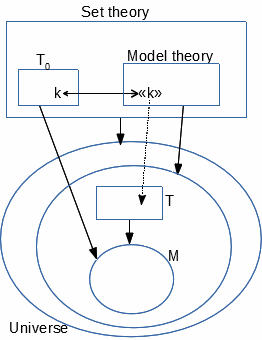 Given a theory T so described, let T0 be the external
theory, also inserted in set theory, which looks like a copy of T as any
component k
of T0 is the copy of an object serving as a component of T.
In a suitable formalism, T0 can be defined from T as made of
the k such that Universe⊨ ⌜k⌝∈T, i.e. the value of the quoting term
⌜k⌝ interpreted in the universe belongs to T.
Given a theory T so described, let T0 be the external
theory, also inserted in set theory, which looks like a copy of T as any
component k
of T0 is the copy of an object serving as a component of T.
In a suitable formalism, T0 can be defined from T as made of
the k such that Universe⊨ ⌜k⌝∈T, i.e. the value of the quoting term
⌜k⌝ interpreted in the universe belongs to T.
But there is no general
inverse definition, of T from a T0 with infinitely many
components, as an object cannot be defined from a given infinity of
meta-objects. Any infinite list of components of T0 needs to fit
some definition, to get the idealized image T of T0 by
interpreting that definition in the universe. (The defining formula must be bounded for
T0 to match the above definition from this T).
This forms a convenient framework for describing theories and their models,
unifying both previously mentioned set-theoretical and model-theoretical frameworks :
all works of the theory T0 (expressions, proofs and other
developments), have copies as objects (by interpreting their quotes) formally
described by the model theoretical development of set theory as works of the
theory T. In the same
universe, any system M described as a model of T is indirectly
also a (set-theoretical) model of T0.
But as a first-order theory, set theory cannot exclude non-standard universes, whose
interpretation of FOTs is non-standard (with pseudo-finite objects). There, the
following discrepancies between T0 and T may occur :
- Any T with an infinity of components also has non-standard
ones; but T0 only copies its standard components.
Then a model of T0 may fail to be a model of T by not fitting
some non-standard axioms of T.
- T may be inconsistent while T0 is consistent, due to a
non-standard contradiction (may it use non-standard axioms or only standard ones).
Such a T has no model in this universe, letting models of T0
either only exist outside it, or also in it with the above described failure to be a model
of T.
So understood, the validity conditions of this unified framework are usually accepted as
legitimate assumptions, by focusing on well-described theories, interpreted in standard
universes whose existence is admitted on philosophical grounds.
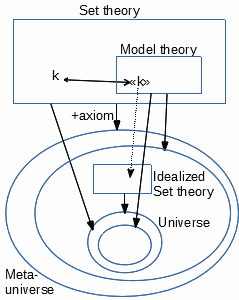 Set theory as its own unified framework
Applying
this unified framework to the choice of a set theory in the role of T0
(describing M and idealized as an object T), expands the tools of interpretation of set theory into itself
(1.7). As T0 co-exists at the same level with the set theory serving as
framework, they can be taken as exact copies of each other (with no standardness issue),
which amounts to taking the same set theory with two interpretations : M called
"universe", and the framework interpretation called "meta-universe".
But the second
incompleteness theorem makes them differ as follows. The statement of existence of
a universe of any given set theory T (and thus also the stronger
statement of existence of a standard one), expressed as a set theoretical statement
interpreted in the meta-universe, cannot be a theorem of T. This shows the
necessary diversity of strengths between useful axiomatic set
theories, which will be further commented in 2.C.
Zeno's Paradox
Achilles runs after a turtle; whenever he crosses the distance to
it, the turtle takes a new length ahead.
Seen from a height, a vehicle gone on a horizontal road approaches
the horizon.
Particles are sent in accelerators closer and closer to the speed of
light.
Can they reach their ends ?
Each example can be seen in two ways:
- the «closed» view, sees a reachable end;
- the «open» view ignores this end, but only sees the movement
towards it, never reaching it.
In each example, a physical measure of the «cost» to approach and
eventually reach the targeted end, decides which view is «true», according
to whether this cost would be finite or infinite (which may differ from the first
guess of a naive observer). But the realm of mathematics, free from all
physical costs and where objects only play roles, can accept both
views.
As each generic theory can use binders over types, it sees types as wholes (sets)
and «reaches the end» of its model seen as «closed». But any framework encompassing
it (one-model theory or set theory) escapes this whole. Now set theory has multiple
models, from a universe to a meta-universe (containing more sets : meta-sets, and
new functions between them) and so on (a meta-meta-universe...). To reflect the
endless possibilities of escaping any given universe, requires an «open» theory
integrating each universe as a part (past) of a later universe, forming an endless
sequence of growing realities, with no view of any definite totality. The role of
this open theory is played by set theory itself, with the way its expressions only bind variables on sets.
Set theory and foundations of mathematics
Next : 2. Set theory